Sunday, February 1, 2015

Water Balloon Theory for Female Saddle Discomfort

Well, I'd rather not say I've been spending my time thinking about women's privates, but after a conversation with a few ladies recently I guess I have to admit to having given this more thought of late than I'd like to.  The result of that thought is shared below.

Part 1 - What I've read about bicycle seats and women's fit on them.

Let's start where everyone does and talk about sit bones
.  If I sit upright enough to firmly plant my ischial tuberosities, I'm sitting upright and not able to reach the handle bars of road/tri-bike set-ups - that is unless I hunch or round my back somewhere.  Sure, women's bike frames aim to help this, but I think that some of the thought processes behind the WSD concept, which have included: women have shorter torsos relative to their leg length; women may bend from the waist while men pivot more at the hips; women tend to sit further back on their saddles than men, possibly due to different distributions in muscle mass (ref 1) - are missing the boat.  Rotating our pelvises forward so as to maintain a strong core while reaching the handle bars pushes soft tissue directly into the nose of most saddles and is highly uncomfortable - I think that's why we as a gender tend to sit upright and farther back on the saddle. Personally, I want to rotate at the hips because this better positioning gives me much more power and feels more stable.  It's also the common positioning on a TT bike.  But guess what - this powerful positioning also completely disengages the ischial tuberosities from the saddle.  Therefore, I simply don't understand the frequent recommendation to choose a saddle based on a body part that is never going to touch it. (ref 1 = http://www.blayleys.com/articles/womensfit/).  

A browser search for bicycle saddles easily returns many results but seldom any actionable information on how to choose one, apart from reiterating reference to sit bones and that women have wider hips than men and may need a wider saddle.  An article on Cobb's site (Ref 2) describes a couple of trends they've found in fitting female cyclists.  The first is explained as a difference in hip orientation that results in some women having more prominent behinds but not a prominent pubic bone while others with flatter behinds may have more prominent pubic bones.  They go on to describe girl parts as being either more pronounced and exposed vs. being more enclosed and drawn up internally and have observed a 2nd trend between this and pubic bone prominence.  They've found that women fitting their trend tend to prefer certain models of their saddles and thus suggest one simply determine into which camp she falls - innie, or outie.  Sounds straight forward enough, I guess, if one knows how their parts stack up against those of other women.  The thing is, picture for a moment someone with an outie belly button.  It's only outie relative to an innie, right?  I mean, no one's belly button actually protrudes beyond the surface of their stomach - at least, not that I've seen.  So if you've never seen another belly button, how do you know which kind you have?  And really, wouldn't you need to see several to know whether yours is generally regarded as an innie vs. outie? 
(Ref 2 = http://www.cobbcycling.com/articles/female-cyclist).

Cervelo does not produce saddles but have shared a really thoughtful presentation on saddle comfort that includes pressure point mapping (of a male rider).  (Ref 3)  This piece comes around to suggesting 4-1/2 rules for choosing a saddle that I'm mentioning because I appreciate their rational and scientific presentation of information, some of which is useful if perhaps you haven't already been trying for years to find a comfortable saddle.  In short, their advice is 1) wide enough, 2) flat enough, 3) firm enough, 4) maybe a cutout, 4.5) T or pear shaped.  Unfortunately, this didn't provide me with additional direction since there are many saddles available now with cut-outs and still not many offerings on how to select among them.  (Ref 3 = http://www.cervelo.com/en/engineering/ask-the-engineers/the-four-and-a-half-rules-of-road-saddles-.html)

Part 2 - Water balloon
theory (volume and compressibility).

So now we come to my thought experiment where I was considering what happens when you squish a water-filled balloon vs. squishing a basketball.  To ease embarrassment, let's call the soft tissue 'the balloon' and the *sensitive* tissue inside the soft tissue 'the gem'.

What happens when you place the balloon on a firm surface and push straight down on it?  The balloon squishes out to the sides, away from the pressure.  I think there is also an increase of pressure inside, but as long as there is room around the periphery for expansion, a gem inside the balloon is perhaps not too bothered.  Now let's think of the balloon inside a snug box, so it is both on a firm surface (the saddle) and also restrained on the sides (the riders legs).  When you push down on the balloon there is now a dramatic increase in pressure inside and the gem is being strangled.  In the first case, a mild increase in friction may be eased by using a lubricating product (shammy cream).  But in the second case, no cream or shammy design is going to relieve substantial pressure to the gem.  

Saddles with central cut outs or grooves that run to the front of the saddle provide a means of pressure release.  But the amount of room needed for pressure release will vary depending on whether you're gem is sitting inside a balloon, or sitting inside a much less compressible basket ball.  If you're on a basketball, maybe a central groove/recess is sufficient to allow comfort.  Heck, maybe those folks don't need recesses at all.  But if you're on a balloon, extra work is involved in finding a cutout that is usefully positioned and both wide enough to allow for the displaced balloon and contents, but that does not result in a saddle so wide as to hinder movement of the legs.


Basically I'm thinking it's not just the orientation - innie/outie as Cobb suggests - or volume (suggested by Cervelo), rather it may be the relative firmness or compressibility of the body part.  Is this water balloon analogy useful?  I'm not sure, but maybe it offers another way of thinking and talking about saddle pressure points.  Perhaps a boob analogy would be better; well, at least that would be one way to get men to understand the issue!  

I know a variety of other factors can go in to what makes for a comfortable experience in the saddle.  Poor bicycle fit is likely common enough and often easy enough to fix to make it a reasonable first question.  Below is my saddle and bicycle fit evolution which aims to support that it isn't always just poor fit that leads to discomfort.  I wonder if I would have had an easier time of it had I known a useful and not-so-embarrassing way to communicate what I was feeling and if the fitters I worked with understood that not everyone benefits from sitting on their ischial tuberosities.

Part 3 - First Hand Experience of a 5'3" enthusiast who's been riding road bikes for >30 years.

I'm guessing my sit bones 
weren't in play here, either

My first 10-speed (circa 1982/3) was a Royce Union that I won off a 5-chances for $1 raffle.  It was most definitely fitted by ensuring I could clear the top tube after the proprietor asked if I was sure I didn't want a women's frame.  Ugh - with the big downward metal swoop that made the thing weigh an extra 10 pounds, no thanks.  It was stolen my first year in college (1989/90).  It's replacement was a Schwinn Caliente with 12-speeds and index shifting (ooh, upgrade) and lasted me until I met a couple of bike racers who thought my cycling enthusiasm deserved a better bike.

The 48 cm Cannondale (now I was up to 14 gear combinations with down-tube shift levers) was born from the extra parts graveyard of several competitive cyclists (1996).  I initially thought the hard leather saddle was brutal compared to the generic ones atop my prior bikes but came around to wearing padded shorts and eventually put enough miles in to condition my interface.  Putting in still longer miles however revealed how fucking stiff and unforgiving this tiny aluminum frame was.  The super short top tube also resulted in significant toe overlap with the 700 cc wheels which I thank for honing my skills in riding a straight line up steep climbs.  In fact, unless I used 23 mm tires (not 25 mm) the front tire actually rubbed the down tube.  That's how tight the clearance was.  This led another ex-bike racer to wonder if the fork was bent.  Either way, it was suggested again that I could probably be more comfortable on a different frame.

The Cannondale preceded the digital era
and is pictured here during my first century
I narrowed my choices for a new bicycle to two.  The Giant TCR1 (size small) was fitted with a shorter stem and seemed ok during my test rides.  The LiteSpeed had that perfect like-a-glove fit, was very comfortable to ride, looked sharp as hell, and was titanium (drool).  It was also unfortunately twice my budget.  I bought the Giant (2001) and spent years fondly remembering the LiteSpeed I let get away (sniff).  With the original stem returned to the bike I quickly recognized I was less comfortable than I was on the test rides but I didn't know which size/angle the shorter one was so didn't know how to replace it. The bike shop should have been more eager to help me out and I should have been more vocal about requesting it because I entered a new unhappy world of saddle discomfort which the women's saddle I chose (Fizik Vitesse) did nothing to alleviate.  
The Giant TCR1 had brake-lever-integrated
shifting; a nice upgrade from all my prior bikes
Fizik Vitesse, aka 'the fun ruiner'


Saddles with cut-outs were appearing but I heard they were a gimmick that caused pinching (eek).  I tried (purchased) another saddle of the same usual shape
Terry saddle resembling 
the tester
  
This is similar-looking to the 
gel-middle saddle I tried
(seemed there was less variety back then) with a central gel insert (can't remember which one but it resembled the Selle Italia pictured) however this offered no relief and I returned to the Fizik.  In 2010 I couldn't go on and was in agony training for my first full distance triathlon.  I asked around about refitting a bike I already had (vs. buying a new one)
and found a shop with a saddle trial program (Guys Bicycles
in Feasterville, PA).  They recommended I find a comfortable saddle first and then have the bike refitted after for best 
Adamo ISM Typhon
results.  

The first tester was a Terry (don't remember model) which was a wild improvement.  Figuring I shouldn't settle on the first one I next tested the Adamo ISM Typhoon and selected it since it seemed even better than the Terry.  Though comfort on the Giant was improved following changes to a much shorter stem, seat post with a different off-set (to move me forward), adding aero bars, and using the Adamo saddle (albeit slightly incorrectly), it still didn't seem quite right.  Fit aside, I also felt like I might benefit from different gearing (the Giant has 53/39, 9-speed 12x25) and so it was time to look for another bike.

In 2013 I moved on to a 50 cm Trek Domane with women's specific design (shorter top tube, taller head stack, with 10-speed 11x28, & 50/34 on a rather long 172.5 mm crank), unfortunately fitted to the saddle that came with it (Bontrager Afffinity RL WSD).  To quote the fitter (from BikeLine of Valley Forge), "most women like this saddle".  Turns out, even on what should be an appropriately-sized WSD bike, I am still not 'most women'.  That saddle has a small anatomical relief zone but its position is completely unhelpful (way too far back if I'm in the drops).  After several months, my tri coach refit the bike with the Adamo saddle.  
Bontrager Affinity RL Women's
'gender appropriate contour
relief zone' does not match
my anatomy at all
In 2010 the long and ample cut-out present in the Adamo ISM saddle had been such a welcome relief to the soft tissue smashing and tearing (yes, tearing) I experienced on other saddles, however it's still not the right answer for me.  I don't want to sit forward enough to have soft tissue hanging completely off the saddle (as it is intended to be used), and the thing is too bloody wide to sit on as done with most other saddles, though that is how I'd been using it (though positioned only on the front half).  (Zip ties void the warranty, which I don't really care about, but they also don't help enough.)  After 4 years on the Giant+Trek running concurrently with 3 years on my Cervelo it added up to where I couldn't stand the contact with my inner legs any more.  It was irritating my hip adductors and hamstrings, hindering my pedal stroke, and despite owning two of them, that saddle just had to go.


I ordered a Koobi 232T for the Cervelo (48 cm PC2) last summer (2014) after seeing an overlay of it with an outline of 'the competitors saddle' on an advertisement stuck into a race packet.  It's a nice improvement to the Adamo with regard to width between the legs, and with that adage 'the stronger a rider you are the less weight you're putting on the saddle' I find this saddle pretty ok for 4 h of riding.  Unfortunately that's not enough to hold me over for 112 miles.  I hope to fix this by finding a way to add more watts instead of having to buy yet another saddle.


(Ref 4 - http://www.stevehoggbikefitting.com/
bikefit/2011/09/all-about-smps/)
Intrigued by the design of the SMP saddles, which are even thinner between the legs than the Koobi, maintain a substantial central cut-out, and also possess a profile that looks to completely remove forward pressure, I decided to give the Evolution a try on my Trek via my shop's saddle trial program (Cadence Cycling and Multisport in Manayunk, PA).  For the first time ever (Jan 2015), I feel evenly and well-supported on a saddle, and I feel evenly and well-supported in every riding position: on the tops, on my brake hoods, in the drops, and even when stretched and lying on the handlebars as in aero position OR when sitting upright riding hands-free.  Oh dear god, where has this saddle been all my life ?!?  This saddle brand (like most) comes in a couple of flavors with variations in width, specific profile, and of course firmness.  I found this blog post (Ref 4) to provide an easy-to-follow presentation of how the various models relate to one another and ordered a Drakon after reading it.  That post also has the best depiction and description I've ever seen regarding how the pelvic bone structure sits on a saddle, and you should read it.  'Sit bones', my ass!  I'm siting on my inferior pubic ramen and loving it.  :-)

Conclusion - While writing this recap successfully offered me a fair bit of nostalgia, what I really wanted to convey is that many factors go in to achieving comfort on a bicycle and I find it darn disappointing that trial-and-error still plays such a significant role.  It's time consuming, it's frustrating, and it's expensive.  There really aught to be a better way.

Update: a newer post on saddle issues (here).

Monday, August 25, 2014

Race Report - Spectating Ironman Kalmar, Saturday 16 Aug 2014


Our group consisted of my friend Marianne, competing in her 3rd full IM, her mom Lena, and I, all traveling from Piscataway and Philadelphia via Newark to Stockholm, and my aunt Pat and her friend Sandy, traveling from Milwaukee via Chicago.  Collectively Lena, Sandy, and Pat are referred to here as the Moms.  On the 5th day, we took the train from Stockholm down to Kalmar.

We arrived in Kalmar on Thursday and it looked as though there was no line when Marianne checked in.  The expo in general looked good, while the IM gear for purchase looked much less nice (in my opinion) than what was available at IM Boulder (which had the best gear I've seen so far).  Mercedez was the corporate sponsor, which sounds posh to me but perhaps is not so over there?  This race site had a far higher incidence of smoking than I am used to.  (Yuck.)
The host hotel (Calmar Stadthotel) is at the
finish line and bears an ironman flag.  Sandy and
Pat shared the room on the top floor, overlooking
the finish. 

The pre-race meeting had the same ol' boring info.  Held before dinner, but still only athletes were allowed in.  I and many others huddled by open doors to listen in.  Fun facts: Only 14% of registered athletes were female.  Some 48 countries were represented.  In my counting of those listed in the spectator guide, only 6 women and 17 men were from the USA, and only 1 woman and 2 men were from Canada.  But I understand the guide is incorrect in its listing of the Pro's, as the on-line results showed a couple of more North Americans (2 USA-F, 1 CAN-M) here.  Get this, 52% of the 2700 registered athletes were first-timers!  I guess this explains why they so thoroughly went over what you put into each of the transition bags.  Also, and this is different, they stated that family could bring you nutrition as long as it was handed to them immediately after the special needs area.  The water was said to be 22 deg and the race was wetsuit mandatory; in fact, it is only permitted to fully remove the wetsuit once in the changing tent.  Exiting the water the suit could only be lowered to the waist.  I wonder if these things were also b/c so much of the field were newbies; are Europeans naked under their wetsuits??  Ironman Kalmar does not hand out tickets that allow a friend to collect your race things on your behalf, so even the last finishers had to go do this themselves.  One more vital piece of info - this race has a 16 h cut-off.  I knew Frankfurt was shorter at 15 h, but had no idea that the 17 h allowed in North American races was not the norm.  Based on the intermediate cut-offs, it seems Kalmar expects participants to be faster bikers (by 15-30 min depending on rolling start swim start time) and runners (by 30-45 min) than what's allowed in the States.   

The water was filled with very
many of these jelly-fish-looking
things (which did not seem to
sting) as well as with many
small fish.
The single pre-race swim was held Friday morning, from 7-8 am.  Instead of following a set course, this appeared to be a free-for all of swimmers moving in all directions.  My feet were cold when I stepped in but I immediately thought the water felt great when I got moving.  We were both pleasantly surprised by the very low salt content but a little concerned about the number of visible sea creatures.  Despite a warning to the contrary by a fellow Philadelphian and ST forumite, we found the water to have decent visibility.

At this point I fear I brought bad luck to Marianne, who was missing a part needed to secure her seat post to the bicycle.  So we spent a sizeable amount of time between the swim and gear check-in zig zagging by foot from bike shop to bike shop in search of this missing part, covering ~4.5 miles.
This British athlete has a dinosaur on his stem
Bike covers were mandatory

Check in to transition area.  So many people were wearing their buckled helmets and race belts while merely pushing their bicycles that I thought this was actually required.  One of the Moms thought those people were just very concerned about forgetting something so this was their way of being sure they didn't, but I think there were too many doing this for that explanation.  I wonder if it may be a requirement of some other popular European race.  Turns out this was not a requirement here, but the bicycles were all checked for soundness which I haven't seen since my first couple of triathlons in 2002/3.  A couple of bicycles had whimsy attached.  And here, the US-forbidden bike covers were in mandatory use!

Swim entry - temporary ramps set in a location
where swimming is not normally permitted
The race start was un-dramatic and played a canned recording of the national anthem, which to me seems underwhelming for the start of a 16 hour endurance race involving thousands of people.  The race used a rolling swim start with swimmers self-seeding by estimated finishing time, beginning with 1:05 and going up in 10 min intervals from there.  Our group was split up while walking with Marianne to the swim coral; Pat and Sandy found a place to watch Marianne enter the water while Lena and I headed over to the docks to get a very up close look at the swimmers going by, mere feet from us, perhaps ~1.7 mi into their day. This course wins hands down for the closest swim viewing out of the IM events I've seen.   


1 of the 2 two most unusual swim
courses I've seen, took place in 
the Kalmar strait, which is a part 
of the Baltic Sea

Sitting so close I was occasionally splashed


Swim exit, which was located closer to transition
(<25 m) than any other full IM I've been to


Despite the stream of constantly shifting spectators, we were all able to move over to transition in time to see Marianne again.  Lena and I saw her go under (swim) and over (bike) the small bridge next to transition and Pat/Sandy saw her come out of the change tent and head for her bicycle.  I nearly got a picture of her at the start of the bike, but my camera focused instead on an adjacent spectator's head.

After leaving transition, athletes head north
and then east over to complete the Oland
lap (shown on the other map).  They return
coming close to the transition area before
heading north for the Kalmar lap.
The Oland loop.  I believe the athletes
complete 112 km when the round the
round-a-bout just north of transition.


At this point we all headed back to and met up at the hotel for breakfast, where I tried to figure out if there was any way to see Marianne during her bike.  This race does not provide any kind of busing to alternate locations, and the provided course maps could have used a blow up of the area near transition to better show how close the cyclists came prior to ending their ride.  I was able to get a more detailed view by looking at the Garmin files from prior year's participants, and found out that the turn around between the first lap (over to and around the southern half of Oland) and the second lap (north of Kalmar) was indeed close by.  We had about 1 h of down time before we headed over, which I used for getting showered and trading my pants, layered long-sleeved shirts, and jacket for a t-shirt and skort.

Cyclists in the foreground facing left are coming
in from Oland.  Those in the middle coming at the
camera or heading right are going out on the next
lap.  Cyclists completing the ride would be heading
to the left against the far fencing, but not are
shown here.
When we arrived at the bike spectating spot, the weather was beautiful - sunny and warm with no noted breeze.  It was a very festive scene with many people, up-beat music booming through speakers that were suspended by a crane, and the race announcer calling out participant's names as they passed around the round-about.  

Marianne has completed ~122 km while other
racers are heading back to transition
This all changed quite a bit however, before Marianne arrived.  The music was replaced with an interview conducted in Swedish and many of the spectators left after the pro's finished the bike segment and/or their athletes came through.  Then it started raining which drove away the other casual spectators.  On the bright side, this made it very easy to see Marianne b/c those spectators remaining were huddled under shelters instead of up against the fencing.  Soaked, we headed back to the hotel for another wardrobe change and to grab lunch, during which the race winner finished the event in 8:13:01. Unfortunately, all I could see was the wreath he was holding above his head b/c there were so many people around the finish chute.

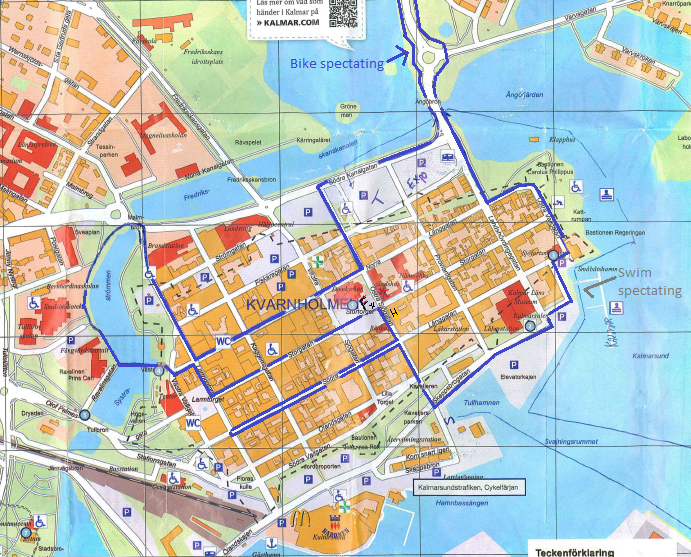
The race was easy to watch from this part of town.  Our hotel,
marked with an H, was adjacent to the race finish (F).  Swim start
(S) was just 3 blocks south, transition (T) was 3 blocks north.  At one
point, the round about was busy with cyclists and runners (marked
as Bike spectating).  The thicker blue lines show how the run course
zig zagged through town, by many shops and restaurants.


We made it over to transition in time to see Marianne come in off the bike and to wish her well as she started the run.  She was stung several times by a bee stuck in her bike helmet and lost some valuable time on the bike between that and a windy course, but she remained in good spirits.

The run course is 3 loops.
Aid station 7 gives out colored
bracelets that denote how many
laps have been run.  Once the
racers have 3 bands, they may
proceed through the finish shoot.
(The finish is their 4th time
through the old part of town.)
I ran back to the hotel to put on running stuff, and then headed out to a portion of the course where I thought it wouldn't be too obvious if I ran casually along the side of the course with Marianne.  I picked her up just north of our bike viewing spot, so got to see a bit more of the area.  Stockholm and Kalmar are both just loaded with multi-use trails; it's really quite wonderful.  I peeled off at a horse pasture (located just south of the northern-most loop), stopped to talk with the horses briefly, ran another lap of this middle portion of the course by myself, and then waited to pick her up again.  Then I peeled off prior to approaching the transition area and ran back to my room, pondering if there was enough sun light left for a swim, but thought better of heading out for a solo swim with no one knowing where I was.  I changed again (adding yoga pants, a long-sleeved t-shirt, and grabbing my jacket), and ran over to take some pictures of things we had not yet gotten to see.
Cat art by the beach
Port-a-urinals kept the lines short 
for the port-a-poties

One of several very cute houses in the area


There was an energy conservation fair in town
the day before the race.  We also saw one of

these electric cars in Stockholm.

The run course crosses this bridge
and goes through the stone gate
Runner's view of the bridge.  This old and
central part of Kalmar is surrounded by water.
The same gateway as above, with yours truly
providing a sense of scale


Ceiling of the gate way
There were a couple of rooms.  This one is
gated off, as was a stairwell down.  Another
room was being used as an active glass shop.


This map of the city shows the stone wall that
surrounds it
Through the stone wall, looking back


Then things became less certain.  I didn't have cell service in Sweden and the hotel wi-fi and/or Ironman's website seemed perhaps saturated.  This made it impossible to get an update on Marianne's pace or where-a-bouts.  In general, viewing participants on the run was quite simple as it passed right by our hotel (three times plus again for the finish) and the finish line was also right there.  I found the Moms along the fencing and we waited as it grew darker and more chilly. 
View from the second story of our hotel.  The three people in the lower left along the fencing are Lena, Sandy, and Pat.  Photo credit - this was pulled from the race live stream on eu.ironman.com.
Eventually we had the sinking feeling the night wasn't going to end well, and I took off running upstream alongside the course through town, looking for her.  After I found her I raced back to tell the Moms she was on her way, and I snapped what should have been a great photo except that my camera was not set for night time photography. 

I decided to run with Marianne for the last lap, not knowing whether I'd be helpful or annoying.  Leaving the center of the city, she was checked to be sure she had the right number of bracelets (participants got a colored "scrunchy" placed on their wrist for each lap they completed) and was noted as being one of last participants to get by the check point.  

Now I got to see much more of the run course, some of which was quite dark and illuminated only with candles.  This made me glad I was along as running through here alone I think it'd be easy to lose focus and perhaps even be creeped out.  Passing the horse pasture a course marshal on bicycle instructed me I was not allowed to run/walk alongside Marianne.  I am aware pacing isn't allowed, but have seen people run portions of a course before so concluded no one cared what back-of-the-packers did.  I guess Swede's are more hard core about the rules.   I sped up, made like I was heading back to town at the path intersection, he went away and I then fell in several yards back of Marianne.  

The course entered a residential areas with quite lovely modern houses, and several people still sitting outside with food, drink, and music.  After a mile or so a different course marshal biked by and asked what I was doing on the course.  I said I was just a kind samaritan out for a lovely walk, at which point he laughed and told me to go keep Marianne company.  I later saw this man's picture in the spectator guide as one of the event organizers.  He biked with Marianne before I caught up and radioed to others about her position.  We passed someone who was stopping to sit down; he didn't make it.  I tried to be encouraging, but now that I think back on it, I should have stopped to talk with him.  The woman we knew was behind us came blazing past apparently deciding she'd had enough of this and finding the energy to do something about it.  We came upon another two women walking, one a participant and the other her friend; this woman from Germany managed to pull out the last record-able finish of the night, 15:59:55.  The remaining spectators seemed intreged by the last participant who was going to be permitted to finish, and many of them pulled out cameras as we passed.  As we approached transition I was told that I had helped enough and I couldn't go on, at which point I cut straight to the finish line to update the Moms.  Then I got as close to the time clock above the finishing arch as I could, aiming to capture a finish that would not go in the record books.  I thought she'd be officially listed as a DNF for not crossing under 16 h, but they list her as a DQ!  Shit, I hope that's not my fault :-(  :-(

Marianne earns a 24 minute PR!
Photo taken from the
Athlete Guide

Sunday, August 10, 2014

Race Report - Ironman Boulder, Aug 2014

-- Race morning (staying at Hotel Boulderado). I got up at 3:45 a.m. and was out the door by 4:15 a.m..  I walked a couple of blocks to run special needs (to drop bag off) and to the high school (to add nutrition to my T2 bag), and got into what looked like a very long line for the shuttles to the reservoir.  It moved along pretty well.  At the reservoir, I put my nutrition on my bike and got into a slow-moving port-a-potty line.  With only 10 min left for pre-race swim, I threw my wetsuit on as fast as possible and dove into the water.  Then I walked my morning clothes bag to its drop-off spot and joined the massive swim-start line, all while in good spirits for kicking butt.

-- Swim at Boulder Reservoir. This was my first race using a rolling swim start (swimmers self-seed against finish time signs, similar to how marathon corrals work), which seemed like such a humane way to start the day.  I was short of breath immediately during the swim, which is not unusual but it didn’t dissipate like it usually does.  This was made worse by the sensation of hands being clasped around my throat.  I was pulling at my wetsuit neck line with such a furry that I realized two things simultaneously: I needed to calm down before I shot my self over the line of full panic, and I probably needed to act more calm (even if I didn’t feel it) before I convinced someone to pull me out of the water.  I’m guessing I was ~0.7 miles in to the swim before I had comfortably regulated my breathing, but I still had an uncontrollable reflex action of pulling at the neckline of my wetsuit throughout the next mile.  I was certainly more calm in this IM swim vs any other with regard to my proximity and contact with other swimmers, and never felt like I was simply cruising along at my usual “steady as she goes” pace, which is why I am a bit disappointed by my swim time.  But since I couldn’t get my wetsuit to stop strangling me I changed my head position to ease up on the pressure – head higher when straight ahead and tilted back when breathing to the side.  I doubt my form is generally very good so can’t really say what kind of effect this may have had on my time.  Water temp of 74 deg had me a little warm by the time I got out.  What would have been better –a wetsuit only from the waist down --> floatation pants with no choking!  This was an easy to follow triangular course with no leg heading directly into the sun - - > bonus.  Some are reporting they think the course was long.  My Garmin indicated 2.62 miles but truthfully, I’ve never only traversed 2.4 in a course of that distance before.  If someone could teach me to swim in a straight line, I’d greatly appreciate it.  For what it’s worth, the GPS trace of my swim trajectory doesn’t actually look that bad. 

Swim + T1 and a few feet of Bike
-- S-to-B transition (Boulder Reservoir). I think this may have been the shortest distance T1 of any of my IMs, at 0.31 mi.  (I logged 0.46 mi in Wisconsin and 0.49 in Mt Tremblant).  I passed the strippers b/c it’s easier to run in my wetsuit than to run while carrying it, and it really doesn’t take me any time at all to get it off now that I know about TriSlide.  One minor ding – no fluids in transition?  My throat was pretty dry. 

Gear issues -- I messed up multisport mode on my Garmin.  Hitting the lap button just brought up new swim segments, which I noticed within the first few feet on the bike when I couldn’t find the screen/display I wanted.  So I started a new bike ride and later a new run, and throughout the day never knew what my overall time was.

-- The bike course was nice with mainly rolling hills; the only thing steep enough to get me out of the saddle was a very short (reportedly) 14% grade at ~mile 103.  The climb up Cheminn Duplessis at Mt Tremblant, which we hit twice, was significantly more challenging.  I think the difficulty factor for Boulder was the lack of shade, dry air, and thin atmosphere which combined to make the sun feel very intense.  I went through an unprecedented 10 bottles of fluids.  Ten.  True, one of them was used solely to douse my head/chest/back but still, 9 (20-24 oz) bottles and I never needed to pee.  I had a hard time eating because my mouth was so dry that chewing wasn’t wetting my food enough to swallow it.  I passed more than one participant lying under a bush to catch a little reprieve from the sun.  I passed another lying down in the road b/c his legs had seized up.  The cyclist in front of me hopped off his bike to help and I offered salt, which was the only helpful thing I had. 

The single-loop 112 (only one very short out and back segment) was new for me and I anticipated being very lonely.  A number of my events of late have been wave starts with my age group (or relay status) starting last.  This, combined with being a mediocre swimmer, usually leaves me in the dust on the bike course, but not this time.  I rolled this course pretty well, passing people consistently and only stopping to put my dropped chain back on and to reconnect on one dropped hand off.  The volunteers were fantastic – one even ran after me when I missed grabbing the Gu Chomps she had (Seriously, who runs after a cyclist to hand them something?  That was above and beyond the call of duty on her part!).  Some seemed strangely surprised by my request to have bottles with the lid off, i.e. OFF (is there another way to express this?).  Once I depleted the caked nutrition in my bottles, simple bottle exchange was easier than filling on the fly, but I’m actually glad I had my own bottles for most of the course as there were some 3 or 4 bottle-launching  bumps out there (rail road tracks covered with rubber mats, each with volunteers to provide adequate safety warnings).  The roads were otherwise generally in fantastic shape, second only to Mt Tremblant.  One request for the sake of beauty: it would be great if the RD could replace the portion east of I-25 with almost anything else.  I imagine putting us over there creates less of an impact on the locals vs keeping us to the west which is more populated.  I wonder - did those unfamiliar with the area think they had biked to Iowa?  (Yes, I know that CO does not boarder IA.). 

One very strange thing – my Garmin appears to have recorded the entire bike course, but reports the distance as only 97.03 miles (a shortage of 13.4%).  But it also shows 4573 ft of elevation gain, which is remarkably close to the 4496 ft reported on the course elevation profile (difference is 1.7%).  My previous IM course elevation recordings (collated in my Quassy report) ranged from -3.7% to +29.7% vs the reported values:
 - IMMT reported: 1800 m = 5906 ft, found: 5686;
 - IMWI reported: 5780 ft, found: 6437;
 - IMLP (2010) reported: 4326 ft, found: 5601, map has since been updated to report 6898 ft. 
Anyway, it’s a good thing I followed my coach’s plan of keeping my heart rate within a specific range and avoiding obsessing about my speed because, with my watch showing an average 14.4 mph, I would have been in a panic looking at that. Yes, really - I only monitored heart rate and cadence for this entire ride.

T2 on the track/field of Boulder High School.
Black squares are changing tents.  Brick color
line to F is the finish on Pearl Street.  Green H
is the Hotel Boulderado.
-- T2 (at Boulder high school) was loooooong.  It had to be more than a quarter mile between dismount (where solid blue line becomes dotted with white) and bike hand off (where blue dots start), and almost another quarter mile before hitting the run start (solid red line).  The path was narrow and people walked their bikes where they wanted, which did not leave a clear line for those of us with enough spunk and desire to run it.  I have to think those who left their shoes on the bike and ran barefoot regretted that decision hugely by the time they got their transition bags on the black rubber-asphalt track surface, which I later read on ST had reached 103 deg.  I had help with T2 (she carried my bag, dumped the contents out, and put things I was done with back in) which I greatly appreciated (there wasn’t quite enough help to go around in the women’s T1 tent).  I ran out of the tent toward the sunscreen station but didn’t make it there before changing to a walk.  It was just so-freaking-hot, though I am amazed to hear the high temp was only 86 °F (was it higher over on the east side of the bike course??).  I actually enjoyed all the minutes the nice lady took to put sunscreen on me b/c it gave me a legitimate reason to stand still in the shade provided by her tent.  At this point I seriously wondered why the hell I was continuing – to get another freaking t-shirt?        

-- The run (Boulder Creek Path) was – thankfully – mostly shaded; I don’t know that I would have survived a full-sun run like Challenge AC had.  I was an unhappy camper coming out of transition, lurching along at 14 min/mile and nowhere near the game plan pace.  I think my primary driving force at that point was getting to the closest source of ice, as there wasn’t any in transition.  And when I got it, I put it everywhere: down my front, down my back, in my pants and a few cubes rubbed on my face.  Armed with the knowledge that I should start to feel better, I slowly increased my pace and reached the intended range for miles 4 and 5.  But this was complicated to hold between the course being very twisty-turny-undulatey and my walking a portion of each aid station in order to fuel up.  Remember, I came in slightly under nourished from the bike because I couldn’t swallow my food.  My Garmin and the race splits disagree quite a bit, but both show I failed to maintain any pace consistency. 

The "Flux Capacitor" run course consisted of 3 out-and-back segments, run twice.  The jagged nature of the line reflects actual turns on the path, and not that I was stumbling like a drunk!
The spectators along the route really helped.  Many of them called me out by name and told me I looked great, stay strong, etc which I know sounds like nonsense but it did help keep me engaged in something other than the early misery of having 20-how-many-? miles left to go.  Some things loosened up and I was beginning to feel pretty good, simultaneously with some things tightening up or chaffing uncomfortably and beginning to weigh on my mind.  But the beauty of the course and the tranquility of the trickling creek really helped to make the experience enjoyable all-the-while.  This was undoubtedly a beautiful venue. 

-- After crossing the finish line I wanted to lie down.  My catcher walked me to get my finishers shirt and cap, and over to take my picture, and offered to get me a chair, but I didn’t want to expend the energy necessary to sit upright – I only wanted to lie down.  I felt ok mentally but noted that I felt physically worse than I did after any other finish – I believe including the 16:36 one at Lake Placid.  My feet were killing me (as they were after Lake Placid), like they had been pounded with mallets, but I also had shooting pains through my legs.  I imagine this was due to the concrete trail we ran on.  I ingested plenty of salt, so don’t think that was my issue.  After a bit I cooled down and one volunteer got me a Mylar blanket.  Then I started shaking uncontrollably and at this point I was no longer successfully convincing the volunteers I was ok.  I managed to get up and get moving before that last one came back with reinforcements, as I think he was going to have me dragged to the medical tent.  Once moving, Pete found me and I found that I didn’t have enough breath to both walk and talk at the same time.  I was very winded.  I warmed up with a bath but couldn’t rest at all b/c my legs were so very uncomfortable.   

Despite still feeling pretty lousy, I went back outside for the final 20 min to cheer on the people who had been at it literally all day long.  I was amazed those crossing in the final minutes before midnight looked as good as they did.  I was also a little surprised the crowd wasn’t bigger.  I assume it will grow over future years, but then again, I guess people in Boulder (as in Madison) have enough other things to do that staying up for this isn’t as enticing as it may be in more rural resort towns such as Mont Tremblant or Lake Placid.

How I feel about my day -- I knew this race would be tough.  While I might not be as happy with my overall time as I wanted – goal time being a somewhat-arbitrary number on a piece of paper – I am at peace with it as I can’t think of a single place where I could have given more on this course.  I crossed that finish line with nothing left in the tank, and three days later still felt sensitive to sunlight and short of breath when trying to string multiple sentences together.
               S – 1:36:34 (3 min slower than PR swim at IMMT)
    B – 6:46:14 (4 min faster than PR bike at CAC)
    R – 5:10:43 (9 min slower than IM PR run at IMWI)
    O – 13:51:28 (4 min 12 sec new ironman race PR)

Also want to mention how surprised I am to have moved up in the rankings through the day, from 105th place in my AG for the swim, to 67th after the bike, to 46th after the run, out of what was presumably 133 starters.  Percentage wise, this is a much higher finish (top 35%) than I'm used to (IMWI - 47%, IMMT - 68%, IMLP - 3rd from last).  I'm guessing that the higher-quality athletes made other plans.

-- Other notes on the race venue/management. Pre-race: check-in was a snap, being shorter/easier than for any other of my IMs; combined with CAC in July, maybe arduous check-in procedures are a thing of the past?  The pre-race meeting was held 3 times, which was convenient; it still gave no new info, or even as much info as the very well-done videos that were posted on FB in the week preceding the race, so was not really worth my time (very much like most pre-race meetings).  It would have been nice if our athlete wrist bands allowed us in to practice swims at the reservoir for free, vs the $20 fee.  The $25 gift card for restaurants in lieu of the Friday night athlete dinner was a neat idea.

This event ran smoothly and was less complicated than you might imagine a point-to-point course being.  That said, I would have been one extremely hurting unit if I had to go back over to the high school to collect my bike and bags myself.  As it was, disassembling and packing my bike myself the next morning was a chore.  It would have been nice if morning clothes bags were brought to, and if post-race massage were held at, the finish line.  I enjoyed that the award ceremony and athlete breakfast was outdoors, particularly as we found seating in the shade; it’s nice to sit out in a beautiful space when the weather is nice, but I hope they have a plan in the event of rain. 

On racing at elevation -- I know I’m lucky it was only 86 degrees.  This area has the potential to be in the 90’s this time of year (as it was one week before the race), which probably would have been a nail in the coffin for more than a few participants, myself included.  I shared an airport shuttle ride with a guy who looked to be my age (or maybe up to 10 yrs older) and had finished his 13th iron distance race in Boulder.  He noted that his 14 h race time was a bit longer than his usual 11-12 h finishes and that he couldn’t generate any power on the bike or get his heart rate to settle down.   Other than having trouble catching my breath in the swim, and at the start of the bike, I felt mostly ok and like perceived heat was my biggest issue at the start of the run.  And the truth is I don’t think I was as well-trained for this run as I was for Wisconsin, so maybe my issues there had nothing to do with either heat or altitude.

PS - My hip felt totally fine.  Even days after the event, my hip feels totally fine.  I might be ready to work harder on my running this winter, as long as I stay off concrete paths :-)